Last updated October 15, 2026
ADU Cost Breakdown: The West Covina Homeowner’s Reference for 2026
The average detached ADU in West Covina costs between $290,000 and $380,000 in 2026. But here’s what nobody tells you until it’s too late: contractor quotes for the same 600-square-foot unit can range from $180,000 to $310,000 because permits, utility connections, and site work are routinely excluded from the headline number. This guide names every cost category so you can compare proposals on equal terms, understand what’s actually being quoted, and know which questions to ask before signing anything in West Covina. For a deeper dive, see our Complete Guide to ADU in West Covina.
Quick Answer
A new detached ADU in West Covina costs between $290,000 and $380,000 in 2026 when all six cost categories are included: design and engineering, city permits and plan check, site preparation and grading, construction hard costs, utility connections, and landscaping restoration. The single biggest reason quotes vary by $80,000 or more is that some contractors leave out utility laterals, permit fees, and site work to make their number look lower. For planning purposes, budget $420 to $575 per square foot for a turn-key detached ADU in West Covina, and expect permit fees alone to run $18,000 to $35,000 depending on the project scope.
Table of Contents
- The Six Cost Categories Every West Covina ADU Quote Must Include
- What West Covina Permit and Plan-Check Fees Realistically Total in 2026
- Why Utility Lateral Connections Add $15,000 to $40,000
- Construction Hard Costs: Where the Square-Footage Money Actually Goes
- Design and Engineering: The Line Item That Protects Everything Else
- Fixed-Price vs. Cost-Plus Contracts: Why the Difference Matters in West Covina
- How to Read a Written, Line-Item Proposal and Spot Allowance Traps
- Common Mistakes to Avoid
- When to Call a Professional
- Frequently Asked Questions
- The Bottom Line
The Six Cost Categories Every West Covina ADU Quote Must Include
When we sit down with a West Covina homeowner who’s comparing ADU bids, the first thing we do is ask them to line up the quotes side by side and label each line item by category. What they find, almost without exception, is that the cheapest bid is cheap because it’s missing whole categories, not because the contractor is more efficient. A complete ADU quote in West Covina has six parts, and if any of them is absent, the number you’re looking at is not the number you’ll ultimately pay.
Here are the six categories, with what each one covers and why it’s non-negotiable:
- Design and engineering. Architectural drawings, structural calculations, Title 24 energy compliance, and soil reports if the city requests them. Without this, you can’t get a permit. Some contractors fold design into their “free estimate,” which usually means they’re using a stock plan that may not fit your lot.
- City permits and plan check. The fees West Covina charges to review your plans and inspect the work. This is a fixed cost set by the city, not a negotiable line item, and we’ll break down the real numbers below.
- Site preparation and grading. Clearing, excavation, tree removal if needed, retaining walls, drainage correction, and compaction. On sloped West Covina lots in neighborhoods like South Hills or the hillside areas near Galster Wilderness Park, this category can swing a project by $30,000 or more.
- Construction hard costs. Materials and labor: foundation, framing, roofing, drywall, flooring, windows, doors, electrical, plumbing, HVAC, fixtures, paint, and everything else that makes the ADU a livable home.
- Utility connections. Trenching and connecting water from San Gabriel Valley Municipal Water District lines, sewer to the city main or a new septic line, electrical service from Southern California Edison, and gas from SoCalGas where applicable. This category is the most frequently omitted from lowball quotes.
- Landscaping restoration. Putting your yard back after the trenches are dug and the equipment is gone. Sod replacement, irrigation repair, driveway patching if crews used it for staging, and fence repair if sections had to come down for access.
Any quote missing one of these categories will surprise you later. The surprise is always a bill, and the bill is always bigger than the line item would have been if it had been priced honestly from the start.
What West Covina Permit and Plan-Check Fees Realistically Total in 2026
West Covina permit and plan-check fees for a new detached ADU typically total between $18,000 and $35,000 in 2026 depending on the project scope, square footage, and whether the site triggers additional review requirements. That range is based on current city fee schedules combined with the school district fees, health department review, and fire department review that ADU permits, codes & inspections in California require. If your quote doesn’t have a permit line item at all, look closer.
Here’s a realistic breakdown of where that money goes:
- Building permit fee: The city calculates this by valuation. For a $250,000 ADU, expect the building permit itself to run $4,000 to $7,000.
- Plan check fee: Usually 65% of the building permit fee, so $2,600 to $4,500 for the same project.
- School district fees: West Covina Unified, Covina-Valley Unified, and Rowland Unified each have their own boundaries inside West Covina. State law caps school fees for ADUs under 750 square feet at the developer fee level, which runs roughly $4 to $5 per square foot. For a 600-square-foot ADU, that’s $2,400 to $3,000. For anything over 750 square feet, the fees jump.
- Sewer connection and capacity fees: If your ADU connects to the existing sewer lateral, you may avoid the full capacity charge, but if West Covina requires a new connection point, expect $3,000 to $8,000 in sewer fees alone.
- Water meter and connection fees: San Gabriel Valley Municipal Water District charges for new service connections. Depending on whether you need a sub-meter or a separate meter, plan for $1,500 to $5,000.
- Plan check add-ons: Structural plan check, Title 24 energy review, fire sprinkler review if required (some West Covina ADUs trigger sprinkler requirements based on access, slope, or floor area), and accessibility review. These add $2,000 to $6,000 combined.
- Permit processing surcharges and technology fees: The small print that shows up on every jurisdiction’s invoice. Budget $500 to $1,200.
One nuance specific to West Covina: hillside properties and lots within the Very High Fire Hazard Severity Zone (which includes neighborhoods near the hills around South Hills and portions of the city’s northern edge) may trigger additional fire department review, brush clearance requirements, and sometimes fire sprinkler mandates. Those reviews add both time and $3,000 to $10,000 to the permit phase. If your lot is on a slope or backs up to open space, mention it during your first conversation with any builder so the quote accounts for it.
We tell every West Covina homeowner the same thing: the permit number on your quote should match the city’s fee schedule, not the contractor’s guess. A written line-item quote from ADU Builders in West Covina will always separate city fees from construction costs so you can verify every dollar against the city’s published schedule.
Why Utility Lateral Connections Add $15,000 to $40,000
Utility lateral connections are the single most omitted line item in West Covina ADU quotes. A lateral is the underground pipe or conduit that runs from the public main in the street to your property line and then to your structure. For a detached ADU at the back of a lot, you’re often extending that lateral 80 to 150 feet through the yard, across pavement, and sometimes under existing landscaping. The trenching, pipe, conduit, backfill, compaction, and restoration cost real money, and the range in West Covina is $15,000 to $40,000 when all four utilities are involved.
Here’s what each lateral typically involves:
- Water lateral from SGVMWD. The San Gabriel Valley Municipal Water District maintains the mains, but the property owner pays for the service line from the main to the ADU. For a back-lot ADU, that’s usually 60 to 120 feet of copper or PEX line, trenched to code depth, with a shut-off valve at the ADU. Cost range: $3,000 to $8,000.
- Sewer lateral to the city main. Gravity is the problem here. Sewer lines need a minimum slope of 2% (a quarter inch per foot), so the further your ADU is from the main, the deeper the trench. On flat West Covina lots, a 100-foot sewer run can end up 8 to 10 feet deep at the connection point. That means more excavation, more shoring, and more money. Cost range: $5,000 to $15,000.
- Electrical service from Southern California Edison. Your existing panel may not have capacity for an ADU. Even if it does, SCE charges for the connection, and you’ll need a sub-panel at the ADU plus trenching for conduit from the main panel. If you need a panel upgrade or a new service drop, that’s additional. Cost range for lateral work alone: $4,000 to $10,000. Panel upgrades add another $3,000 to $6,000.
- Gas line from SoCalGas, if your ADU uses gas. Many new ADUs go all-electric to avoid this line item entirely, but if you’re planning a gas range, gas water heater, or gas dryer, you’ll need a lateral. Cost range: $2,500 to $7,000 depending on distance and whether a meter is required.
The way to avoid a utility surprise is to ask for a utility estimate before signing a construction contract. In West Covina, SGVMWD, SCE, and SoCalGas each have processes for getting a preliminary service quote, and a diligent contractor will pull those estimates during the design phase so the numbers are real, not assumed. If a bid doesn’t include utility laterals as a line item, ask whether they’re included or whether the contractor plans to bill them as a change order later. The answer tells you everything about how the rest of the project will go.
Construction Hard Costs: Where the Square-Footage Money Actually Goes
When a West Covina contractor tells you an ADU runs $300 per square foot, what they’re really saying is that their hard costs, the materials and labor, come to about $300 per square foot and everything else is on top. Hard costs for a detached ADU in West Covina in 2026 typically run $250 to $380 per square foot for a standard-completion unit, with custom finishes pushing the number higher. Those costs break down roughly like this for a 600-square-foot detached ADU:
- Foundation and slab: $18,000 to $35,000 depending on soil condition, slope, and whether the ADU requires piers or a raised foundation. West Covina’s native soil in many areas is expansive clay, which can heave and shift with moisture. A proper soil report and foundation design aren’t optional here.
- Framing and structural lumber: $30,000 to $50,000. Lumber prices in Southern California have stabilized somewhat since the 2021 spike, but they’re still 25% to 40% above pre-pandemic levels.
- Roofing: $8,000 to $16,000 for a composition shingle roof on a 600-square-foot ADU. Tile, standing seam metal, or flat-roof systems for modern designs run higher.
- Windows and doors: $7,000 to $14,000. Title 24 energy requirements mean dual-pane, low-E glass, and the specific models affect both comfort and your energy bill.
- Electrical, plumbing, and HVAC: $25,000 to $45,000 combined. This includes rough-in, fixtures, a mini-split heat pump or ducted system, water heater, and all the finish work. For an ADU, a ductless mini-split is the most common choice in West Covina because it handles both heating and cooling through one compact system.
- Drywall, insulation, and paint: $12,000 to $20,000. Don’t skimp on insulation; West Covina summers are hot and the difference between code-minimum and upgraded insulation is a few hundred dollars, but the comfort difference inside the ADU is enormous.
- Flooring, cabinetry, countertops, and trim: $15,000 to $30,000. This is where the price really swings based on taste. IKEA cabinetry versus custom cabinetry, laminate versus engineered hardwood versus tile, builder-grade carpet versus LVP with a thicker wear layer: each choice moves the number thousands of dollars.
- Fixtures, appliances, and finish hardware: $5,000 to $12,000. A basic appliance package runs $3,000 to $5,000. Upgrade to a full kitchen with stone counters, a dishwasher, microwave, and a washer-dryer stack, and you’re at the top of the range.
One decision that affects hard costs more than any other in West Covina is whether to build stick-framed on site or use a prefab system. We work with several manufacturers whose products arrive as modular components and are assembled on site, including Plant Prefab and Boxabl. Those systems can save on framing labor and reduce construction time meaningfully, but the site work, foundation, utility connections, and finishing are the same regardless of how the structure is built. Some homeowners also ask about Tuff Shed for a basic shell approach, which works for storage but rarely satisfies West Covina’s ADU requirements for insulation, plumbing, and mechanical systems without substantial upgrades. James Hardie siding products are a frequent choice for both prefab and stick-built ADUs in West Covina because they hold up well to the dry heat and occasional heavy rain without the maintenance cycle of wood siding.
The important thing about hard costs is that they’re the easiest line items to compare apples-to-apples across quotes because the scope is physical and the materials are specified. The problem is that two quotes will almost never specify the same materials, which is why a written proposal that names specific products and finishes matters so much. It’s the only way to know whether the lower bid is actually lower or just built with cheaper materials.
Design and Engineering: The Line Item That Protects Everything Else
Design and engineering for a West Covina ADU typically costs $8,000 to $20,000, and this is the one line item homeowners are most tempted to cut, because it’s the one that produces drawings instead of drywall. But the drawings are what keep the construction budget honest. Without a complete set of stamped plans, the city won’t issue a permit, the contractor can’t get accurate material quantities, and the utility companies won’t give you a firm connection estimate.
A complete design and engineering package for a West Covina ADU includes:
- Site plan showing the ADU’s location on the lot, setbacks from property lines, driveway access, and existing structures.
- Architectural drawings with floor plan, elevations, sections, window and door schedules, and finish specifications.
- Structural calculations prepared by a licensed California engineer, including foundation design, shear wall requirements, and roof structure. In West Covina, seismic requirements are a real engineering consideration; the city sits in a seismically active region and the structural design has to account for it.
- Title 24 energy compliance documentation confirming the ADU meets California’s energy code. This is a separate document prepared with specialized software.
- Soil report if the city or the structural engineer requests one. On West Covina hillside lots, this is almost always required, and it’s the document that tells the foundation engineer how deep and wide the footings need to be.
If you’re working with a builder who uses a stock plan, the design fee may be lower, but you’ll spend more on customizing the plan to fit your lot and your life. A stock plan doesn’t know where your property line is, which direction the lot slopes, or where the sewer main runs. The point of design and engineering isn’t just to get a permit; it’s to produce a set of documents that lets every contractor bidding the project see the same scope. That’s how you get comparable quotes.
At Seedling ADU West Covina, we include design and engineering in our written price as a separate line item so homeowners can see exactly what they’re paying for and what the documents cover. We’ve seen too many families try to save $5,000 on design and spend $30,000 in change orders because the drawings didn’t specify something simple like the location of the water heater or the width of a doorway. The drawings cost what they cost, but the benefit they provide compounds through every phase that follows.
Fixed-Price vs. Cost-Plus Contracts: Why the Difference Matters in West Covina
There are two ways an ADU contractor in West Covina structures a contract: fixed-price and cost-plus. The difference between them is where the risk sits when reality doesn’t match the plans, and because West Covina has hillside lots, expansive clay soil, and older homes with unexpected conditions, reality often doesn’t match the plans.
A fixed-price contract states a total price for a defined scope of work. If the contractor hits rock when trenching the sewer lateral, or discovers that the existing electrical panel can’t support the ADU after all, the cost to deal with the condition is the contractor’s to bear, not yours. That’s how it works in theory, and it’s how it works in practice when the contract is written properly and the contractor has done their homework. The trade-off is that fixed-price quotes are usually higher than cost-plus quotes because the contractor is pricing in the risk and adding a contingency.
A cost-plus contract charges you the contractor’s actual costs plus a markup percentage, typically 15% to 20%. The customer pays for every nail, every hour of labor, and every surprise. The appeal is that the base number looks lower. The reality is that you’re taking on the risk of everything the contractor didn’t anticipate, and you’re paying the markup on top of the surprise. For a project like a West Covina ADU where underground conditions and existing structure inspections can reveal problems mid-project, cost-plus is a gamble the homeowner doesn’t need to take.
The majority of change-order horror stories we hear start with a cost-plus contract. A trench hits a buried concrete slab from an old patio. The panel box turns out to be a Federal Pacific model that needs replacement for safety reasons. The sewer lateral is 12 inches shallower than the contractor assumed and the slope doesn’t work without a pump. Each of those is a legitimate condition, and each one is a line item on a cost-plus invoice that didn’t exist on the original quote.
Our position at Seedling is simple: every project we build in West Covina is fixed-price, in writing, before any work starts. If a condition changes the scope, we sit down with the homeowner, explain what was found and what it costs, and get their approval before moving forward. The conversation happens before the invoice, not after. That’s the way fixed pricing should work, and it’s the only way we’re willing to build. For homeowners comparing quotes, the contract type matters as much as the dollar amount.
How to Read a Written, Line-Item Proposal and Spot Allowance Traps
A written proposal should tell you exactly what you’re getting, what it costs, and what happens if the wrong thing gets delivered. The problem is that many ADU proposals in West Covina are written to look detailed while hiding vagueness in the line items where it matters most. Here’s how to read one properly:
- Look for “allowance” language. An allowance is a budgeted amount for an item that hasn’t been selected yet, like “$5,000 lighting allowance” or “$8,000 flooring allowance.” Allowances aren’t inherently bad; they exist because homeowners haven’t picked their finishes yet. The problem is when the allowance is set below what the item actually costs so the total looks competitive. If you see allowances, ask what happens when the actual selection exceeds the allowance. The answer should be: you’re told the difference in writing before the item is ordered, and you approve or adjust.
- Check for “by owner” items. Some proposals list certain work as “by owner,” meaning the contractor won’t provide them. Common by-owner items include appliances, window coverings, landscaping, or utility connection fees. If a quote seems $20,000 cheaper than the others, look for the by-owner items. That money doesn’t disappear; it comes out of your pocket on a different invoice.
- Verify every category from the six-category list. Design, permits, site work, construction, utilities, landscaping. If any category is missing, ask where it is. If the answer is “included in the total,” ask for the line-item breakdown anyway.
- Check for substitution clauses. Some contracts say the contractor may substitute materials “of equal quality” without notice. In drywall or lumber, that’s usually fine. In flooring, cabinetry, or windows, “equal quality” is in the eye of the person writing the invoice. Request a clause that substitutions require written approval.
- Look for milestone payments that protect you. In California, contractor payments are regulated. Never agree to a payment schedule that puts more than 10% down or more than the value of the completed work in the contractor’s hands. For a $300,000 ADU, a reasonable schedule might be a 10% deposit, then progress payments at foundation completion, framing completion, drywall completion, and final.
- Confirm the warranty in writing. California requires a minimum one-year fit-and-finish warranty, but the details matter. What does the warranty cover, who’s responsible for labor versus materials, and what’s the process for making a claim? If the warranty section is three sentences long, ask for more detail.
The proposal is the most important document in your ADU project because it defines what the contractor is obligated to do and what you’re obligated to pay. If the proposal is vague, the project will be vague. The written price we provide at Seedling includes line items for every category, specific product selections where specified, allowances only where the homeowner hasn’t chosen yet, and no by-owner items unless the homeowner has asked to self-perform part of the work. You should expect the same level of detail from anyone you’re comparing.
Common Mistakes to Avoid
- Comparing quotes without normalizing scope. If one West Covina contractor quotes a 600-square-foot ADU at $220,000 and another at $310,000, the difference might be real, but it might also be that the cheaper quote omitted permits, utility laterals, and site work. Pull apart the quotes by category before you compare the total.
- Assuming the permit process is the contractor’s problem. It’s your permit and your property. A contractor who says “don’t worry about permits” is either planning to build without one, which creates a liability and resale problem, or planning to hit you with the fee as a surprise. Insist on seeing the permit line item and the city’s fee schedule.
- Ignoring the site conditions you can see today. If your West Covina lot slopes, drains poorly, or has a retaining wall that’s already leaning, your site work costs will be higher than the neighbor’s flat lot. Get the site work priced from the start rather than discovering it during grading.
- Choosing the contractor based on the lowest number. The cheapest quote is often the one with the most missing line items. Ask why the number is lower rather than celebrating it.
- Signing before utilities are priced. SGVMWD, SCE, and SoCalGas each have processes for estimating connection costs. If your contractor hasn’t pulled those estimates before you sign, you’re signing up for an unknown number.
- Skipping the soil report to save money. On West Covina’s expansive clay soils and especially on hillside lots, a soil report is the difference between a foundation designed for the ground it sits on and a foundation designed for a textbook. Skipping it saves $3,000 to $5,000 now and risks a structural problem later.
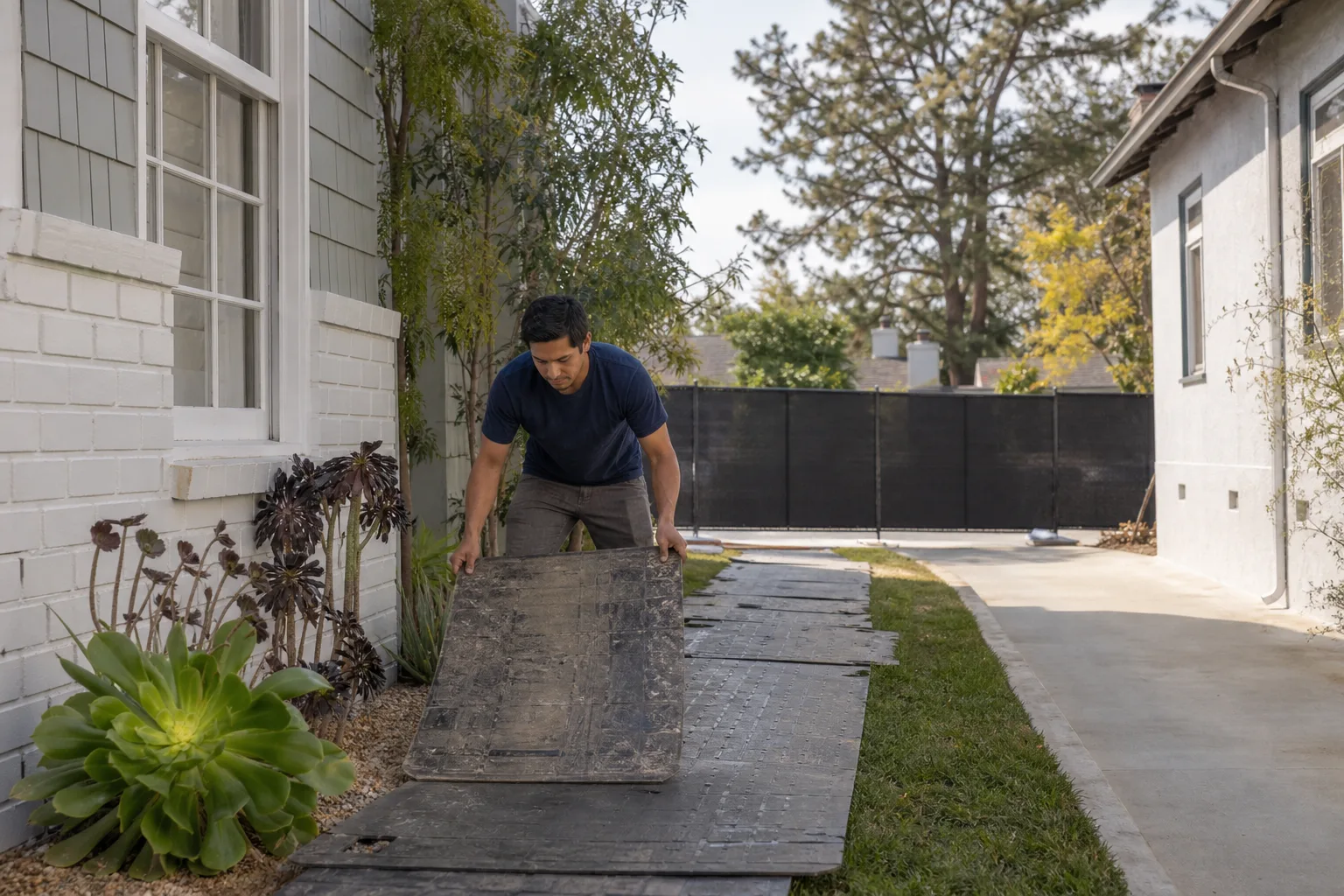
- Budgeting for the ADU but not the disruption. A custom build on your lot means equipment, noise, dust, and a period where your backyard isn’t yours. The right contractor manages this with shoe covers, drop cloths, organized staging, and daily cleanup. The wrong contractor leaves you feeling like a construction site came to live with you. Choose the crew carefully.
When to Call a Professional
The right time to call an ADU professional in West Covina is earlier than most homeowners think. If you’re still deciding between a garage conversion and a detached ADU, a Garage Conversion Contractor in West Covina can walk your property and give you a straight answer about which option fits your lot, your budget, and the way your family lives. If you’re wondering whether your existing house can support the electrical and plumbing load of an ADU, or whether a Home Addition Contractor in West Covina might be a better use of your space, the answers come from walking the site, not from guessing online. And if you’ve got multiple quotes that don’t line up, bring them to someone who can read them side by side and tell you what’s missing. Seedling ADU West Covina offers free estimates in West Covina; call (559) 258-5962 to schedule one, and bring whatever quotes you’ve already collected. We’ll walk through them with you and show you what to look for.
Frequently Asked Questions
A new detached ADU in West Covina costs between $290,000 and $380,000 in 2026 when all costs are included: design, permits, site work, construction, utility connections, and landscaping restoration. That equates to roughly $420 to $575 per square foot for a turn-key unit. Quotes that come in lower are usually omitting one or more cost categories, most commonly utility laterals and permit fees. Call (559) 258-5962 for an exact quote on your specific lot; estimates are free and written, so you can see every line item before making a decision.
ADU quotes in West Covina vary by $80,000 or more because contractors are quoting different scopes, not different work. The most common omissions are utility lateral connections ($15,000 to $40,000), permit and plan-check fees ($18,000 to $35,000), and site preparation costs that vary significantly by lot. A quote that looks cheaper usually includes fewer line items, not cheaper materials or labor. The solution is to ask every contractor for a written, line-item proposal and compare the categories, not just the bottom line.
West Covina permit and plan-check fees for a new detached ADU typically total between $18,000 and $35,000 in 2026. That includes the building permit, plan check fee, school district fees (which vary by district boundary within West Covina), sewer connection fees, water connection fees from SGVMWD, and processing surcharges. Hillside and fire-zone properties can add $3,000 to $10,000 more in review fees and requirements. Your builder should show you the city fee schedule and match their line items to it.
A fixed-price ADU contract includes a total price for a defined scope of work, with the contractor bearing the risk of conditions that deviate from the plans. It should include a written description of every category: design, permits, site work, construction, utilities, and landscaping. Allowances, if any, should be identified clearly, along with the process for adjusting if your selections exceed the allowance. The alternative is cost-plus, where you pay the contractor’s actual costs plus a markup, and surprise conditions become surprise invoices for you instead of for the contractor.
A typical detached ADU in West Covina takes 8 to 14 months from the start of design to final inspection. The design and permit phase takes 3 to 5 months depending on plan-check turnaround and whether your lot requires additional review, and construction takes 5 to 9 months depending on scope, site conditions, and weather. Prefab systems like Plant Prefab and Boxabl can shorten the on-site construction phase, but the design, permits, and utility work run on their own schedules regardless of build method. A reliable builder will give you a written schedule along with the written price.
Yes, and in many West Covina neighborhoods, a garage conversion is the more affordable path to an ADU because the structure already exists. Garage conversions in West Covina typically cost $120,000 to $220,000 depending on the condition of the existing structure, whether the slab needs work, and how much electrical and plumbing infrastructure needs to be added. The trade-off is losing your garage storage and parking space, which matters more for some families than others. A site walk with a builder who does both conversions and new construction will give you the honest comparison for your specific lot.
The Bottom Line
A West Covina ADU is a six-figure investment, and the difference between a project that stays on budget and one that spirals is almost always decided before construction starts. Get a written proposal with every cost category named and priced. Verify the permit fees against the city’s schedule. Pull utility estimates from SGVMWD, SCE, and SoCalGas before signing. Understand whether you’re signing a fixed-price or cost-plus contract, and read the allowance language carefully. When you compare quotes on equal terms, the right choice becomes obvious. When you compare them on the bottom line alone, you’re not comparing quotes; you’re comparing omissions. The goal is a new home on your lot that’s built to last, priced honestly, and finished the way it was promised. For warning signs to watch for during your project, see our West Covina homeowner’s reference.
Ready to get a written price for your West Covina ADU? Call Ben and the team at Seedling ADU West Covina at (559) 258-5962 to schedule your free estimate. We’ll walk your lot, answer your questions, and give you a written, line-item proposal that includes every category in this guide, with no surprises after crews arrive. You can also explore more guides & resources on our blog.
Written by Ben Ortega, Owner at Seedling ADU West Covina, serving West Covina since 2001.